
Finikia/Investment
Investment
Investing is not buying a property, it is committing capital.
The property is merely the vehicle for the expected return.
Before choosing the property, the thesis must hold. Our work is to put the two back in that order.
In investment, the subject is no longer the property, it is the return on your capital. The property is its support: a vehicle judged by its capacity to serve a strategy, not by its appearance.
Many choose the property before setting the thesis, the target return, the horizon, the accepted risk, the planned exit. Our first task is to restore that order: establish the thesis, then verify that the property serves it. The tax and financial dimensions are coordinated with the specialists in our network.
The theses we know how to read
Rental yield
Buying in Paris to let, and selling later. The question is not the hoped-for rent, but the real yield once charges, upcoming works and the energy constraint are factored in, and the liquidity at resale, which is prepared from the moment of purchase.
Value creation through the fabric
Acquiring an asset the market overlooks, and revealing its value through a technical reading others do not perform.
Patrimonial holding
Holding a resilient Paris asset for its preservation and transmission, with yield coming after the security of capital.
Case study
From stated yield to real yield
Illustration of method · Rental investment, Paris
Context & objective
An investor is eyeing a Paris apartment at €400,000, intending to let it at €1,300/month, then sell in time.
At first calculation, the gross yield looks sound (~3.9%), and reselling “in a few years” seems a given in Paris.
Let us take the first of these theses, the most common. The same method applies to the others; only the criteria of judgment change.
Our reading
We pick up the calculation where the agency stops.
Conventional reading vs Finikia reading
The stated yield does not survive the energy constraint. What the investor took as a given – to let, then resell without a discount – was an uncosted risk.
The investment remains possible, but not at this price, and not without budgeting the upgrade. Either the purchase price absorbs the works through negotiation, or the yield thesis does not hold. The client decided on the real yield, not the stated one.
Our intervention
Our role was not to confirm a stated yield, but to bring it back to reality: rebuilding the net yield, factoring in the regulatory risk and the cost of compliance, reading the liquidity at resale.
The same rigour applies to a value-creation or patrimonial-holding thesis: only the criteria of judgment change, not the method.
We turned a thesis built on a listing figure into a decision built on a defensible return.
Traditional approach vs Finikia
The method – the five steps and the verdict in full – is set out in detail on the dedicated page.
How we work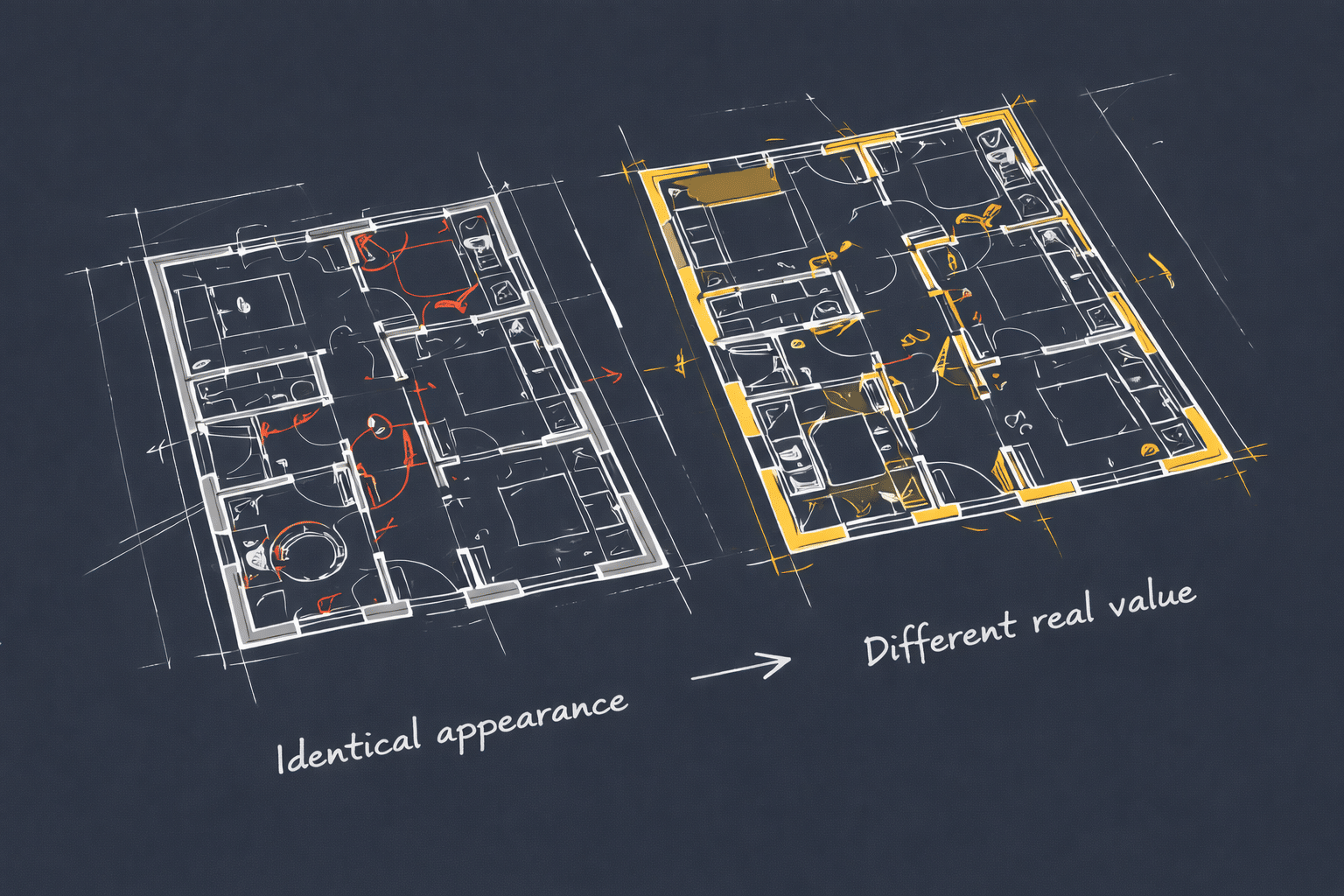

First conversation
Start a conversation
An initial conversation helps define the nature of the engagement; a one-off audit on an asset already identified, or the framing of a search upstream. No commitment at this stage.