Property valuation strategy is often overlooked. What the market shows: a price. An average per square meter. A set of “comparables.” A free valuation. A coherent figure. And a reassuring sense of control.
The real issue isn’t the price, it’s how it’s used
A valuation can be perfectly accurate…
and still lead to a poor outcome.
Why?
Because a price only has value through the way it is applied.
Setting a price is not the same as positioning a property.
And that’s often where everything is decided.

“A well-calibrated price, poorly used, leads to the wrong result.”
What truly drives the outcome of a sale
Timing
A price does not carry the same relevance at every moment.
Launching too high or too low, at the wrong time, can stall a property on the market.
Launch dynamics
The first weeks are decisive.
This is when the market “judges” the property.
An estimate says nothing about this dynamic.
Buyer targeting
A property does not speak to everyone.
The price must align with a specific buyer profile, not with an abstract average.
Real competition
What matters is not the market as a whole.
It is what buyers are actively comparing, at the same moment.
Perception
Two properties at the same price can be perceived very differently.
And perception creates value… or erodes it.
What a valuation never tells you
A valuation does not answer the real questions:
- Should the property be sold now, or later?
- Should it be adjusted before going to market?
- Should the strategy create tension, or secure a faster sale?
- Should the focus be on a price point, or on a buyer profile?
And yet, these decisions are what ultimately shape the final outcome.
“A valuation marks a point. A strategy shapes the outcome.”
The Finikia approach
At Finikia, valuation is intentionally secondary. We begin with:
- a comprehensive reading of the asset
- its true positioning
- the go-to-market strategy
- the possible scenarios
Price is only a consequence. Not a starting point.
Conclusion
A valuation may be free.
But when misused, it can be costly.
Because selling a property is not about finding a number. It’s about structuring a decision.
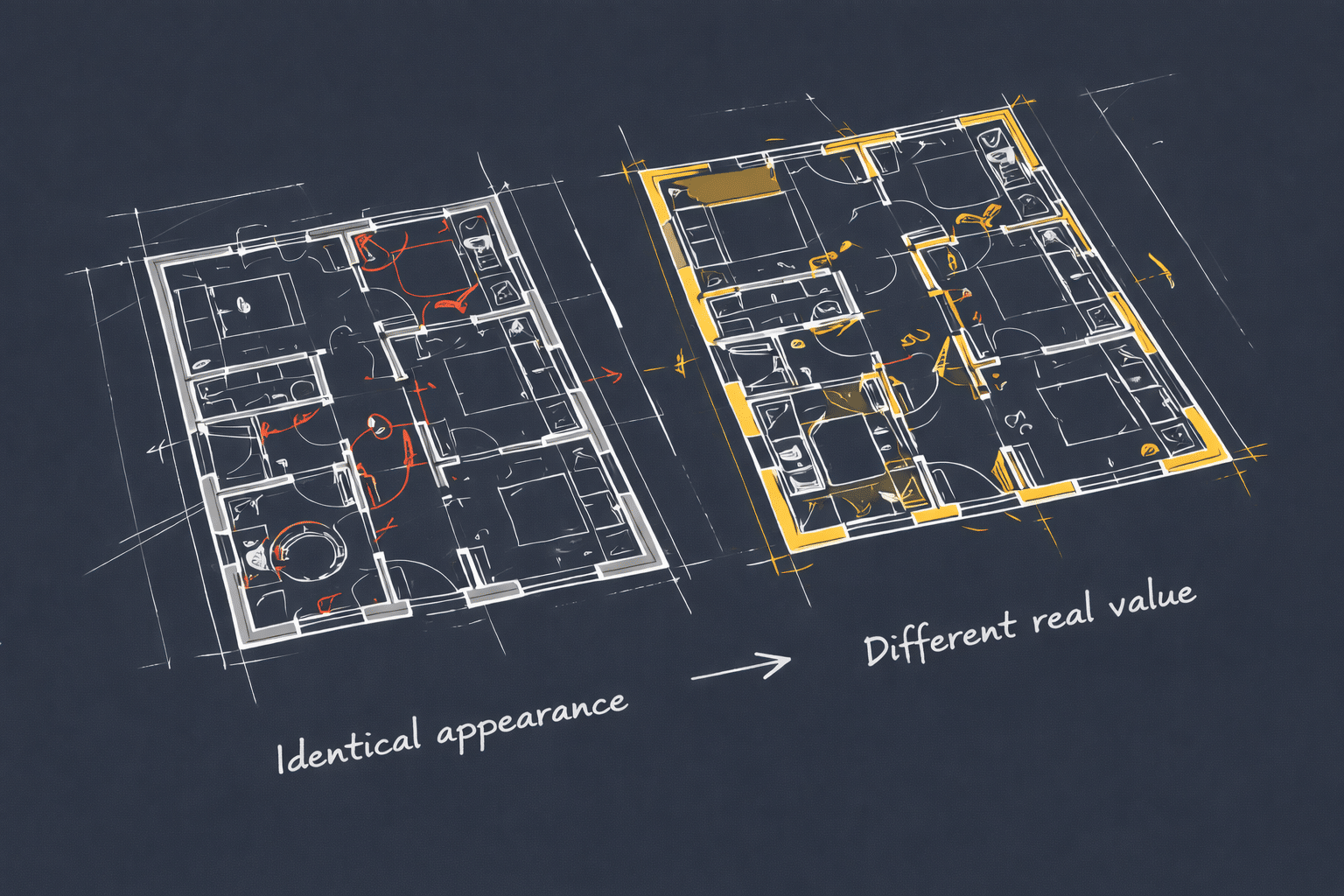
In practice, two properties with the same valuation can follow completely different trajectories, depending on how they are introduced, perceived, and negotiated on the market.